Collected Interiors
2026
Conceptual Design
In these interiors, architecture refuses to disappear behind the art. Elaborately ornamented ceilings, painted vaults and carved fireplaces assert a presence as emphatic as the works placed within them. Across a series of architectural visualizations, Brent Lee explores the relationship between historical architecture, contemporary art and collectible design, bringing together objects and references separated by centuries. The intention is neither to recreate a period interior nor to establish the neutrality of a conventional gallery, but to consider how architecture and a collection might shape one another.
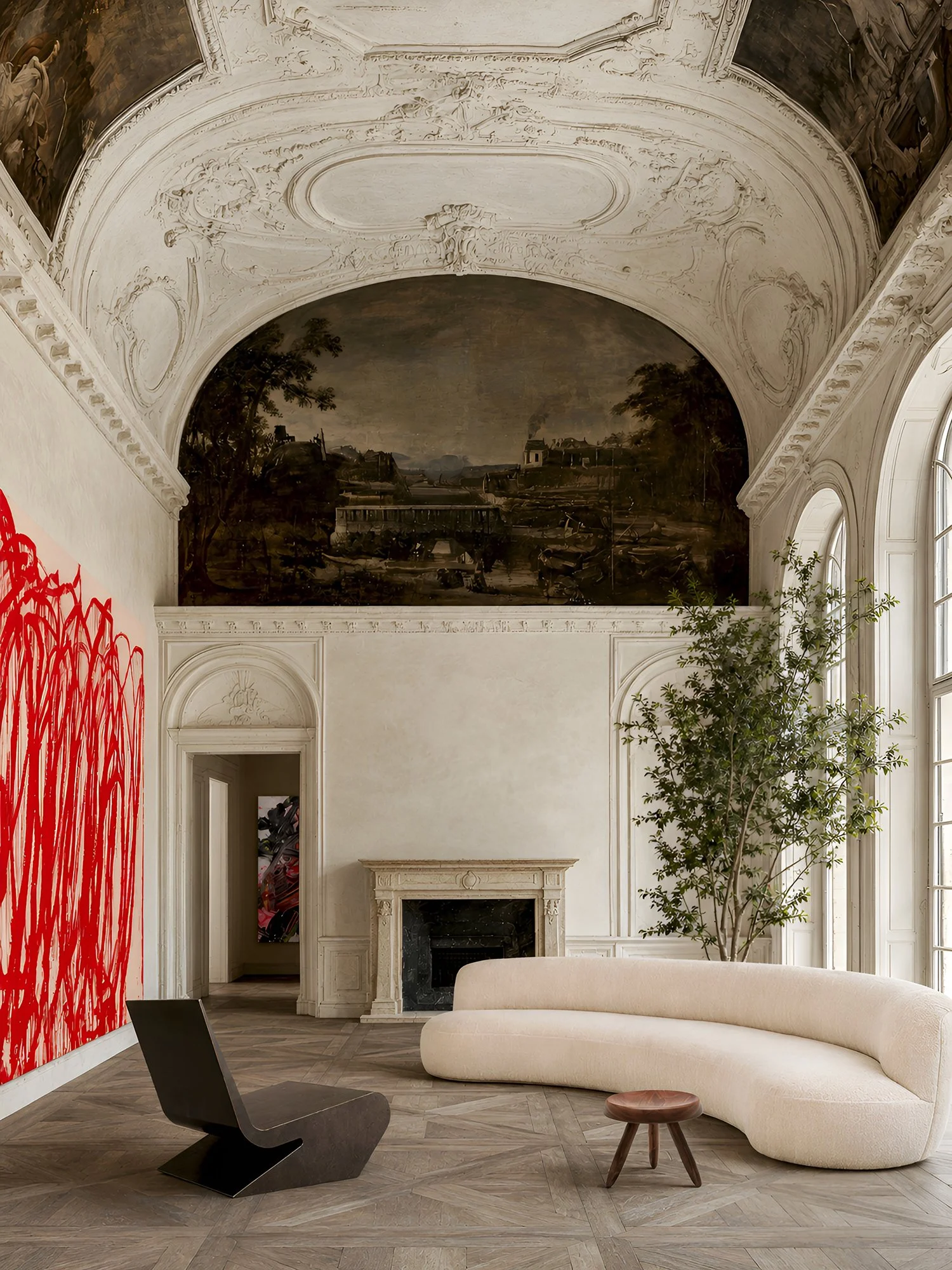
In the first salon, an elaborate plaster ceiling frames a painted landscape, while the expressive red gestures of Cy Twombly introduce an altogether different visual language. Beneath, the generous curves of a Pierre Augustin Rose sofa are met by the sharply folded planes of Lee’s blackened-bronze Babliano Lounge Chair, accompanied by a small timber stool by Charlotte Perriand. Against the intricacy of the surrounding architecture, the furniture appears almost severe. Its restraint allows the individual forms to maintain their presence without competing directly with the ornament above.
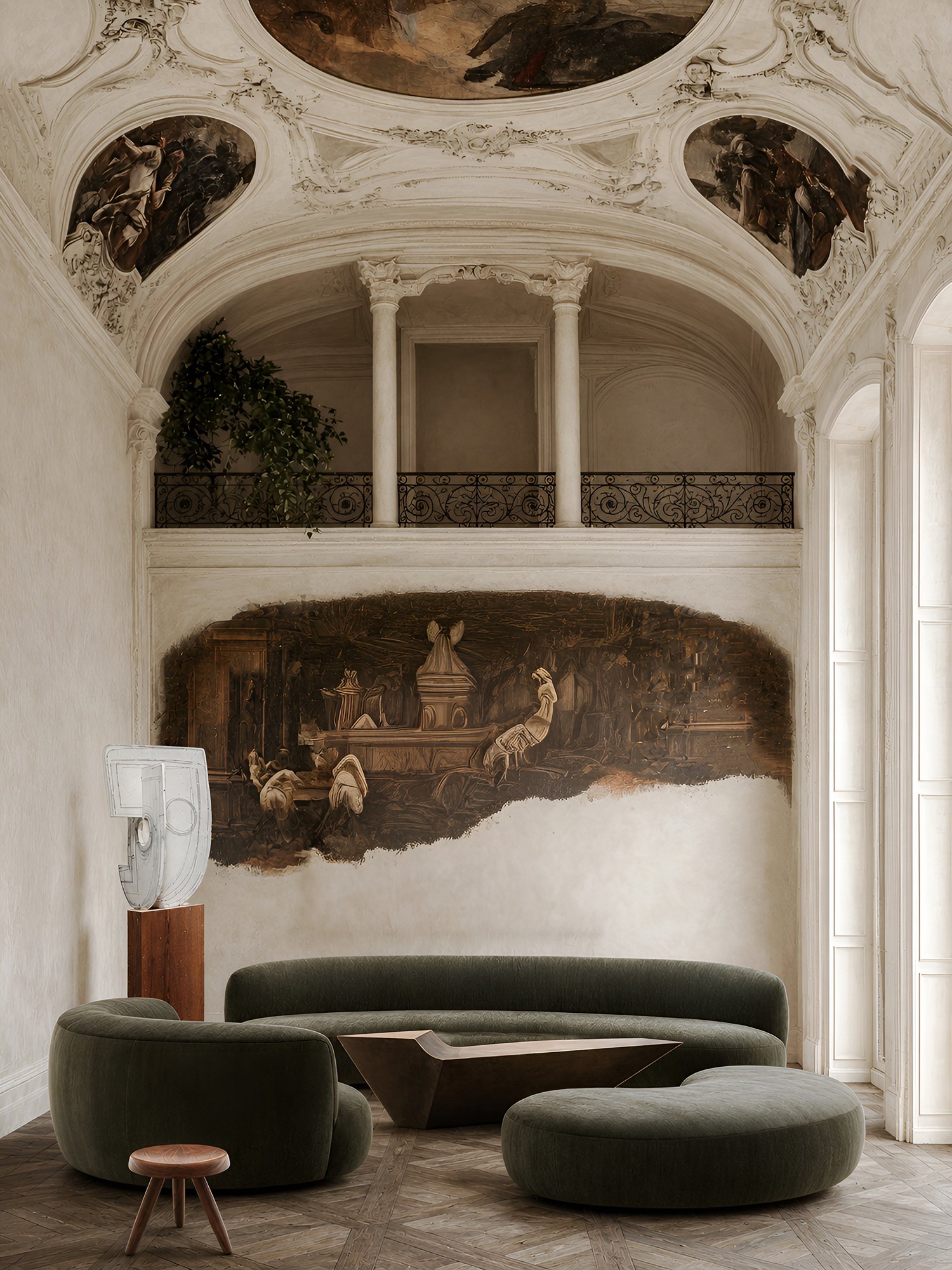
The relationship becomes more sculptural in an adjoining composition, where Thomas Houseago’s Dumb Head (2008) stands alongside Lee’s Babliano Coffee Table I and deep green upholstered seating. The sculpture's roughly worked surface introduces a physicality quite unlike the controlled geometry of the furniture, while painted lunettes and ornamental plasterwork establish a further layer of complexity. Rather than seeking a common decorative language, the arrangement allows these differences to remain apparent, giving each element a particular clarity against its surroundings.
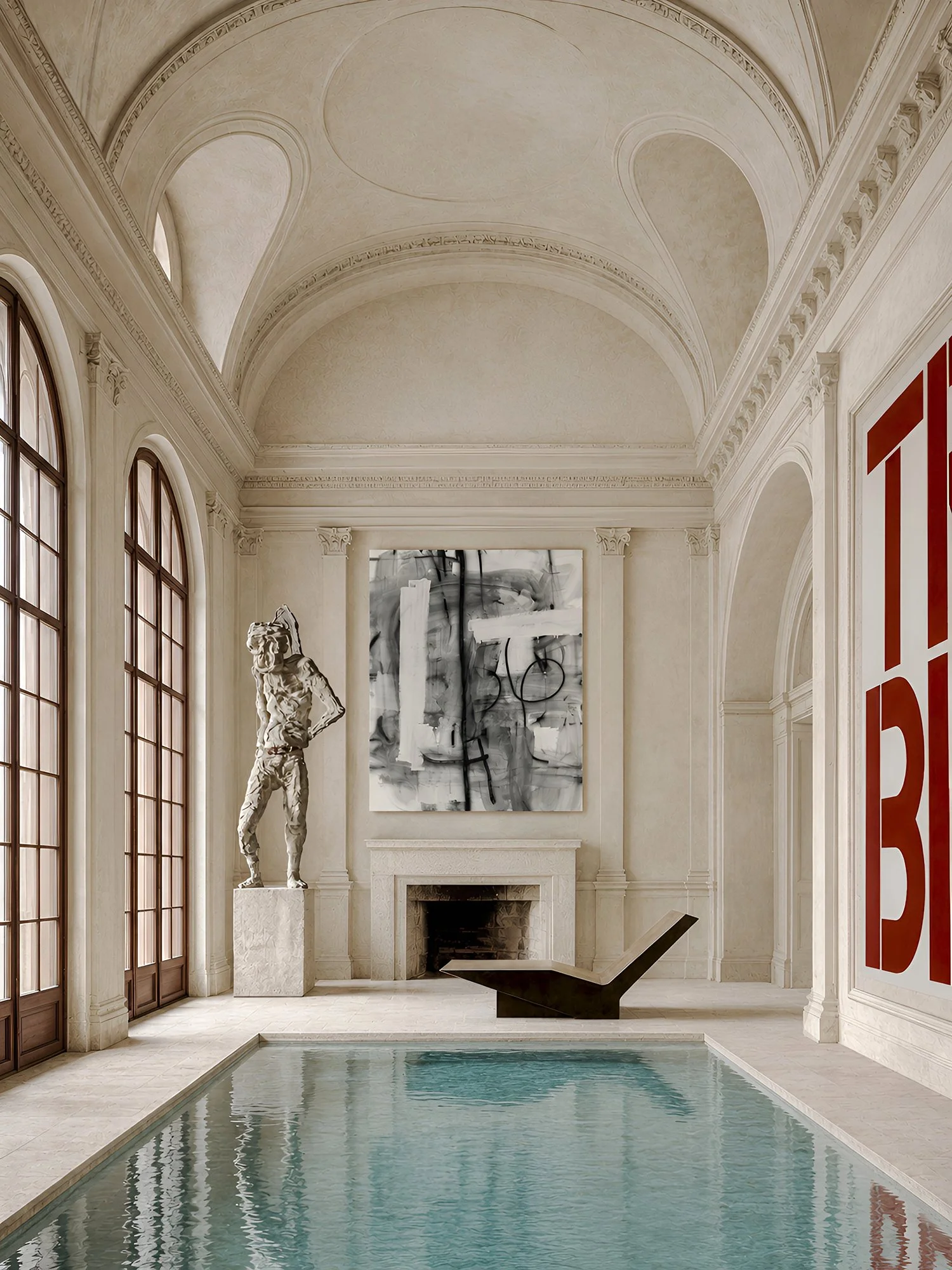
Elsewhere, the architecture assumes an almost monumental scale. A long indoor swimming pool occupies a vaulted hall, where classical detailing and pale stone provide a setting for works by Christopher Wool and Thomas Houseago. Lee’s angular Babliano Chaise Lounge introduces a more restrained sculptural form, positioned close to the water. The pool itself becomes an important part of the composition, its reflective surface introducing movement and subtle distortions into an otherwise rigorously ordered space. The result lies somewhere between a private gallery and a domestic retreat, with neither identity entirely taking precedence.
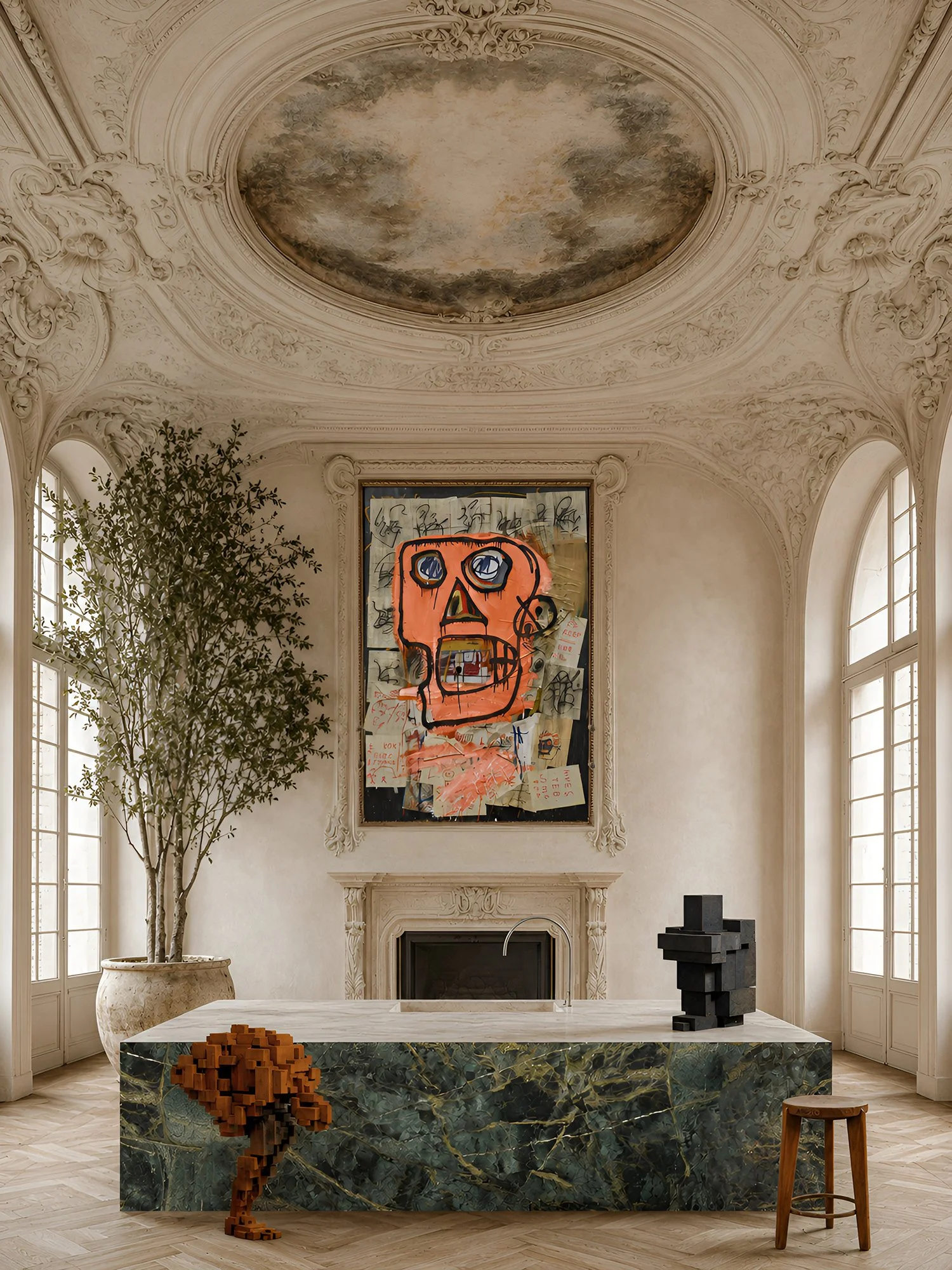
A different relationship unfolds in the kitchen, where Jean-Michel Basquiat’s Untitled (1982) commands the wall above an intricately carved fireplace. Its vivid orange figure is particularly striking against the pale architectural ornament and painted ceiling overhead. Below, a substantial island in richly veined green marble accommodates sculptural works by Antony Gormley, while a modest Pierre Jeanneret stool introduces another generation of design. The placement shifts familiar expectations of both the art and the room. An architectural element ordinarily associated with domestic function becomes an unexpected setting for sculpture, without surrendering its identity as part of a home.
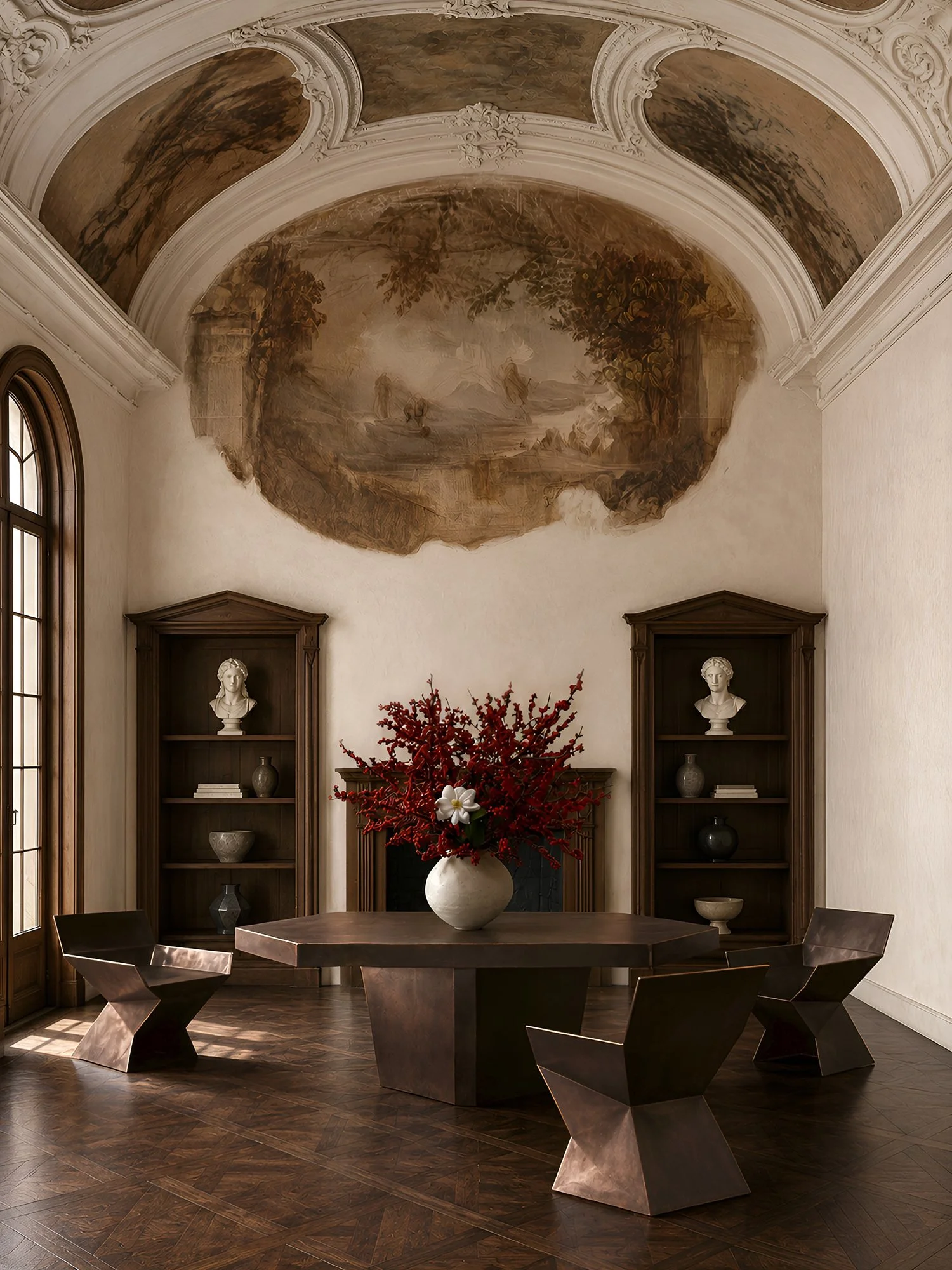
The sculptural potential of furniture becomes more explicit in a dining room, where Lee’s Babliano Table I establishes a bold geometric presence beneath an exuberantly painted ceiling. Its dark bronze surfaces and angular proportions contrast with the delicate plaster ornament, while timber parquet and natural light temper the formality of the composition. Here, the table assumes an architectural significance of its own, occupying the space with an authority more commonly associated with sculpture.
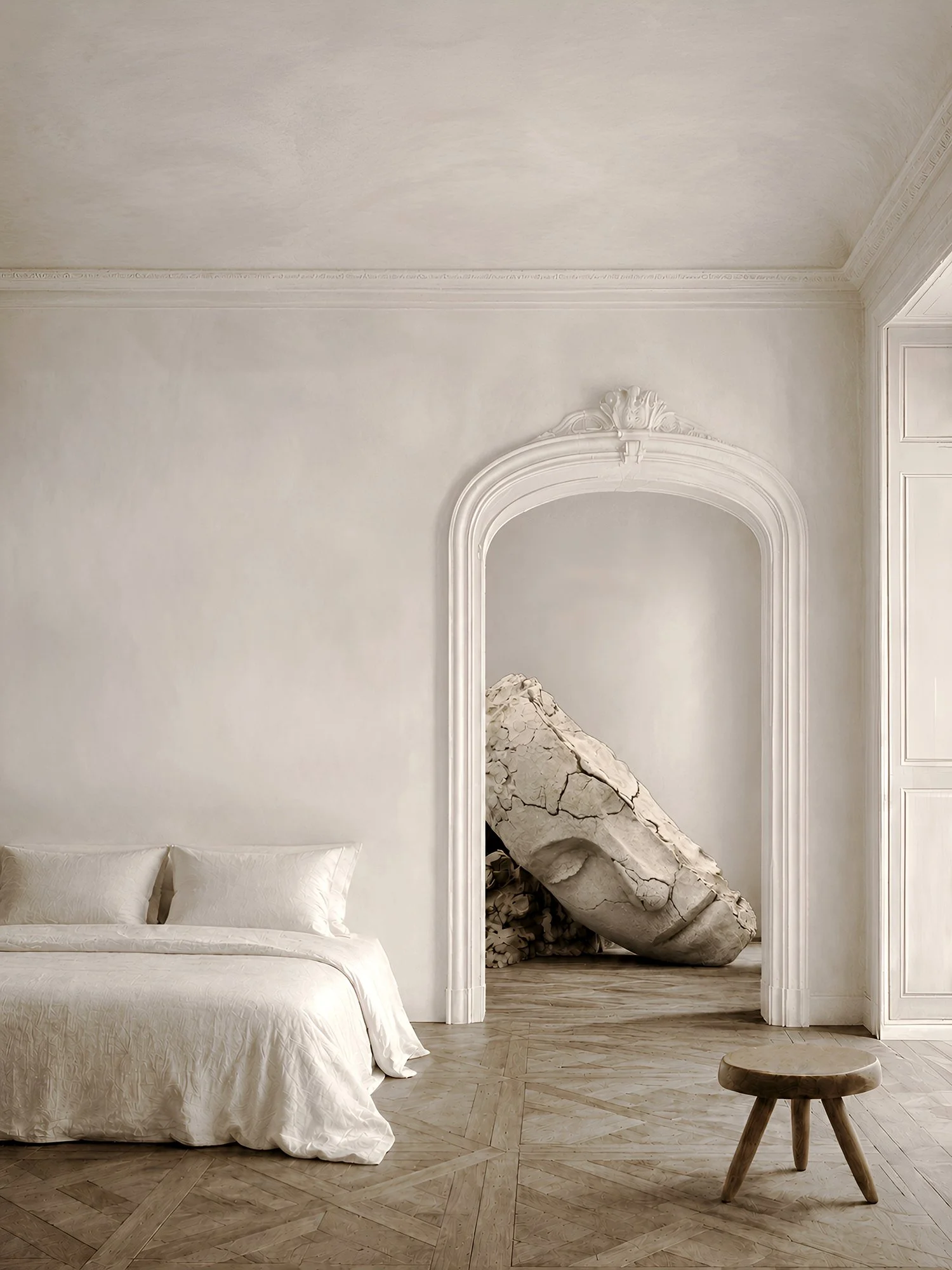
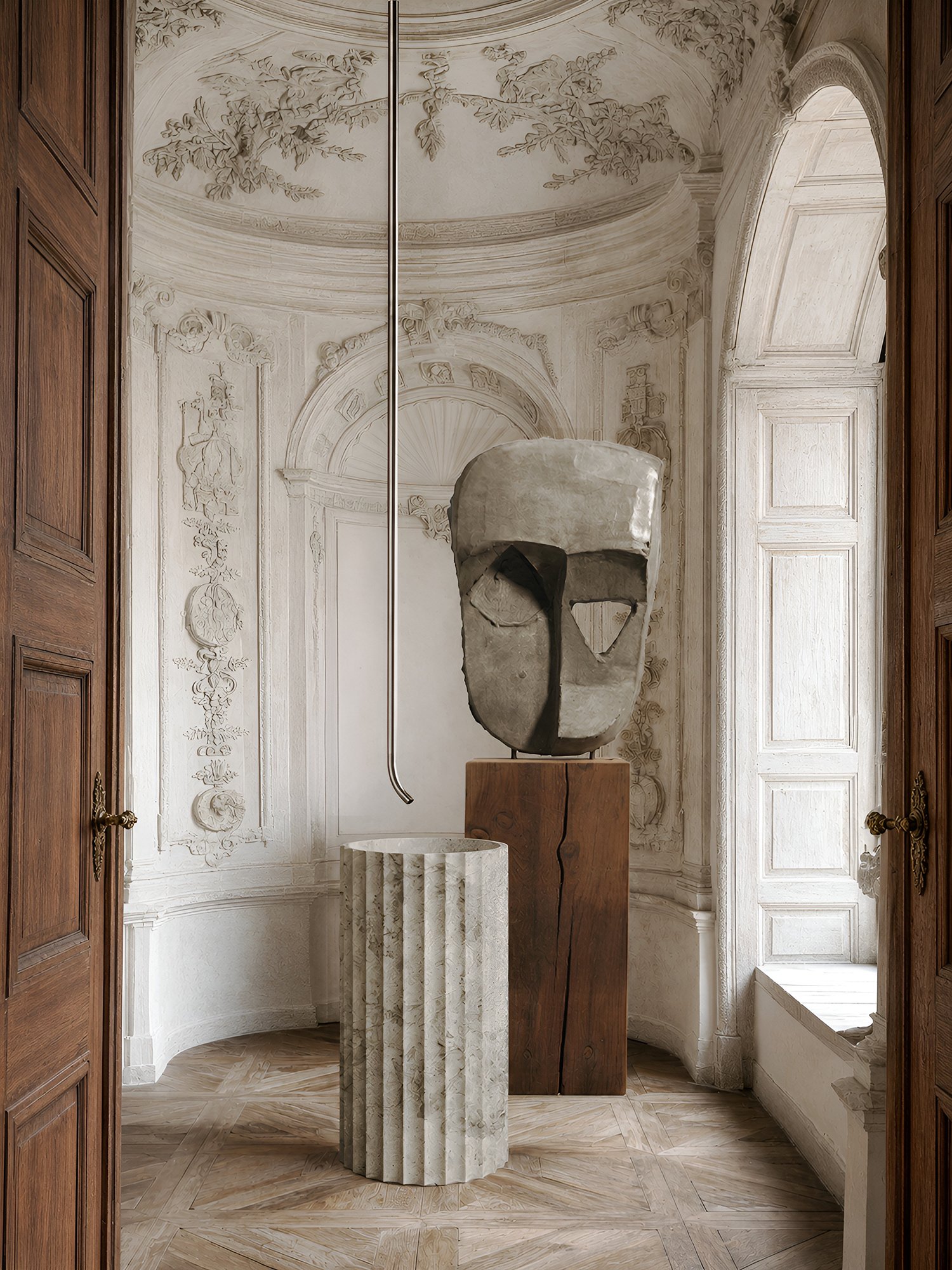
The quieter interiors introduce a different kind of encounter. In a bedroom of pale plaster and aged timber, an arched doorway reveals Mark Manders’s Dry Clay Head (2015–2016), an enormous fragmented face resting in the adjoining room. Its closed eyes and cracked surface suggest an unexpected vulnerability, made more pronounced by the intimacy of the surrounding domestic setting. A small Charlotte Perriand stool sits almost casually in the foreground, establishing a remarkable contrast in scale. In the powder room, Houseago’s Quake Mask (2008) occupies a rough timber pedestal beside a fluted stone basin and a slender ceiling-mounted tap. The sculpture is not isolated within a formal display, but encountered through the ordinary experience of moving between rooms.
Throughout the series, art is allowed to occupy different positions within the architectural hierarchy. At times it dominates an elevation; elsewhere it is partially concealed, discovered through an opening or placed in unexpected proximity to an everyday object. The architectural language is equally varied, moving between historical ornament and contemporary restraint, yet the underlying consideration remains consistent: how proportion, material, placement and the spaces between objects influence the experience of an interior.
What emerges is an approach to residential design in which collecting is inseparable from the character of the rooms themselves. Art and sculpture need not be accommodated by neutral surroundings, nor must contemporary furniture defer to the architecture that contains it. Their differences introduce a richness that a more uniform interior might lack, suggesting a home defined as much by the individual character of its collection as by the architecture in which it is held.
Photographs — Brent Lee mixed-media images